
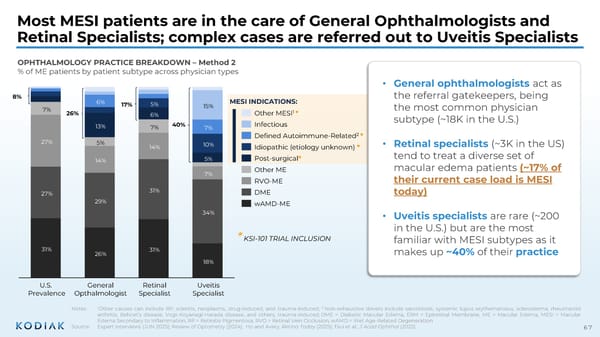
6 7 Other MESI 1 * Infectious Defined Autoimmune-Related 2 * Idiopathic (etiology unknown) * Post-surgical * Other ME RVO-ME DME wAMD-ME Most MESI patients are in the care of General Ophthalmologists and Retinal Specialists; complex cases are referred out to Uveitis Specialists 31% 27% 27% 7% U.S. Prevalence 26% 29% 14% 5% 13% 6% General Opthalmologist 31% 31% 14% 7% 6% 5% Retinal Specialist 18% 34% 7% 5% 10% 7% 15% Uveitis Specialist Notes: 1 Other causes can include RP, scleritis, neoplasms, drug-induced, and trauma-induced; 2 Non-exhaustive drivers include sarcoidosis, systemic lupus erythematosus, scleroderma, rheumatoid arthritis, Behcet’s disease, Vogt-Koyanagi-Harada disease, and others; trauma-induced; DME = Diabetic Macular Edema, ERM = Epiretinal Membrane, ME = Macular Edema, MESI = Macular Edema Secondary to Inflammation, RP = Retinitis Pigmentosa, RVO = Retinal Vein Occlusion, wAMD = Wet Age-Related Degeneration Source: Expert Interviews (JUN 2025); Review of Optometry (2024); Ho and Avery, Retina Today (2025); Tsui et al., J Acad Ophthal (2022) MESI INDICATIONS: • General ophthalmologists act as the referral gatekeepers, being the most common physician subtype (~18K in the U.S.) • Retinal specialists (~3K in the US) tend to treat a diverse set of macular edema patients (~17% of their current case load is MESI today) • Uveitis specialists are rare (~200 in the U.S.) but are the most familiar with MESI subtypes as it makes up ~40% of their practice OPHTHALMOLOGY PRACTICE BREAKDOWN – Method 2 % of ME patients by patient subtype across physician types 8% 26% 17% 40% * KSI-101 TRIAL INCLUSION
 Interactive Corporate Presentation [COPY] Page 65 Page 67